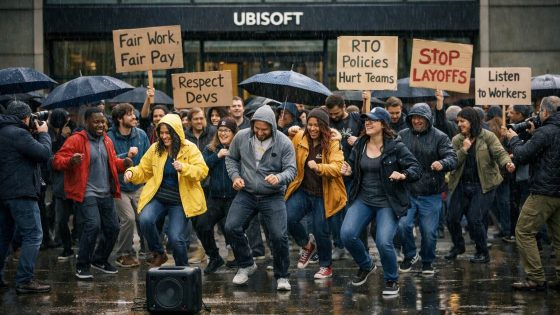

A veteran team lead at Ubisoft Montreal says he has been fired after publicly criticizing Ubisoft’s new return-to-office mandate, a policy that would bring staff back on site five days a week and sharply reduce routine remote work. The dismissal quickly became a flashpoint inside a game industry still dealing with layoffs, studio restructurings, and a growing tension between corporate cost controls and the realities of modern development teams.
The developer, David Michaud-Cromp, confirmed his termination in a short statement posted to LinkedIn, saying he was fired “effective immediately” and that he would not discuss internal details. The firing came only days after he said he had been disciplined with a three-day unpaid suspension that was tied to comments he made about the return-to-office plan. In that earlier message, he said the company framed the discipline as an alleged breach of a “duty of loyalty,” language that has drawn attention because it suggests the line between public criticism and workplace consequences can be thin when policies become controversial.
At the center of the dispute is Ubisoft’s decision to shift to full-time, in-office work for teams, with flexibility offered through a limited annual allowance of work-from-home days rather than a regular weekly hybrid schedule. Ubisoft has presented the change as a way to strengthen collaboration, knowledge sharing, and overall efficiency, arguing that in-person work supports creativity in an increasingly competitive AAA market. But critics inside and outside the company have pushed back hard, especially because the policy arrived alongside a broader corporate reset that included cost reductions, leadership changes, and a shrinking slate of projects.

That context matters. Ubisoft recently laid out a new operating model that reorganizes the company into multiple creative groups and refocuses investments around fewer priorities. The plan included the cancellation of several projects in development and additional time for other games, paired with studio restructurings and expected efficiency moves. Ubisoft also confirmed the end of development on Prince of Persia: The Sands of Time Remake, a decision that became symbolic of the broader shake-up for many players and employees. With big changes landing at once, a strict return-to-office requirement has been viewed by some workers as one more disruption stacked on top of job insecurity.
Michaud-Cromp’s criticism was blunt. In posts that circulated widely, he questioned the idea that bringing everyone back to the office five days a week was really about collaboration, implying it had more to do with corporate oversight and business pressures than with day-to-day productivity. While employees often vent online about workplace mandates, the speed and severity of the response, first a short unpaid suspension and then termination, amplified concerns about how much room workers have to speak publicly about policy changes that affect their lives.
Ubisoft, for its part, has pushed back on the notion that respectful feedback leads to dismissal. In a statement attributed to a company spokesperson, Ubisoft said that sharing feedback respectfully does not result in being fired. The company pointed instead to its internal Code of Conduct and described an escalation process that depends on the nature, severity, and repetition of a breach. That language leaves open an obvious question, what specifically crossed the line, but the developer has said he will not share internal details, and Ubisoft has not publicly provided a more specific explanation.
The dispute is landing in a moment when return-to-office mandates have become one of the most charged issues in the tech and entertainment economy. Game development, in particular, expanded remote and hybrid work rapidly during the pandemic years, and many studios kept some version of that flexibility because it widened hiring pools and helped teams keep projects moving across time zones. At the same time, major publishers have increasingly tightened requirements, often arguing that complex production benefits from co-located teams, fast iteration, and spontaneous collaboration that is harder to replicate through video calls.
Still, employee skepticism has grown, especially when stricter policies appear during periods of layoffs or restructuring. Critics often argue that forcing a full return can function like a soft reduction in headcount, by making conditions difficult enough that some people leave voluntarily, particularly those with long commutes, caregiving responsibilities, or established remote arrangements. Whether or not a company intends that outcome, the risk is real: in a talent-driven industry, sudden policy shifts can accelerate attrition, and losing experienced developers can disrupt schedules and quality.
In Ubisoft’s case, the backlash has already spilled into organized labor activity in France, where multiple unions have called for strike action tied to the company’s restructuring measures and the end of remote work flexibility. The strike window is set for mid-February, designed to apply pressure at a time when investor attention and public scrutiny are typically higher. While labor dynamics vary widely across countries and studios, the call itself highlights a broader trend: more game workers are treating workplace policy as a collective issue, not just a private HR matter.
The situation also intersects with the industry’s wider instability. In one major annual survey of developers, roughly one in ten respondents reported being laid off in the past year, and a far larger share said they were affected indirectly through coworkers or company changes. That persistent churn has reshaped how developers evaluate job security, management credibility, and the trade-offs they are willing to accept. When layoffs, project cancellations, and strict workplace rules arrive in the same cycle, worker trust can erode fast.
For Ubisoft, the reputational risk is not limited to one studio or one employee. A firing tied, even indirectly, to public criticism of working conditions can create a chilling effect that discourages internal debate and damages employer branding at a time when studios compete for experienced staff. It can also inflame public narratives that publishers are prioritizing cost control and corporate discipline over sustainable development practices. On the other hand, leadership teams often argue that clear policies and professional boundaries are necessary to protect colleagues, keep workplaces respectful, and prevent public disputes from turning into personal attacks.
What happens next will depend on how Ubisoft manages the fallout, and whether its new operating model delivers the creative consistency and financial stability it is aiming for. The company may also face a practical test: whether teams can absorb organizational change while transitioning to full-time on-site work without losing key talent. For developers watching from across the industry, the lesson is immediate, return-to-office mandates are no longer just a scheduling issue, they are becoming a central fault line in how game studios define culture, accountability, and trust.
News written by Mike.